
RTL Design &
Microarchitecture
Transforming architecture into high-quality, implementation-ready RTL.
Our RTL Design and Microarchitecture practice is dedicated to translating system-level requirements into scalable, efficient, and resilient hardware implementations. We partner closely with clients from architectural definition through RTL development, ensuring that functionality, performance, power, and area objectives are addressed from the earliest stages of the design cycle.
Our engineers craft clean, reusable, verification-friendly RTL using industry-standard Verilog and SystemVerilog methodologies, with a relentless focus on design quality, modularity, maintainability, and seamless integration across verification, DFT, synthesis, and physical implementation flows.
silicon core
assign ready = valid && !stall;
silicon core
RTL engineering services
Core Capabilities
Architecture to RTL. Built for silicon.
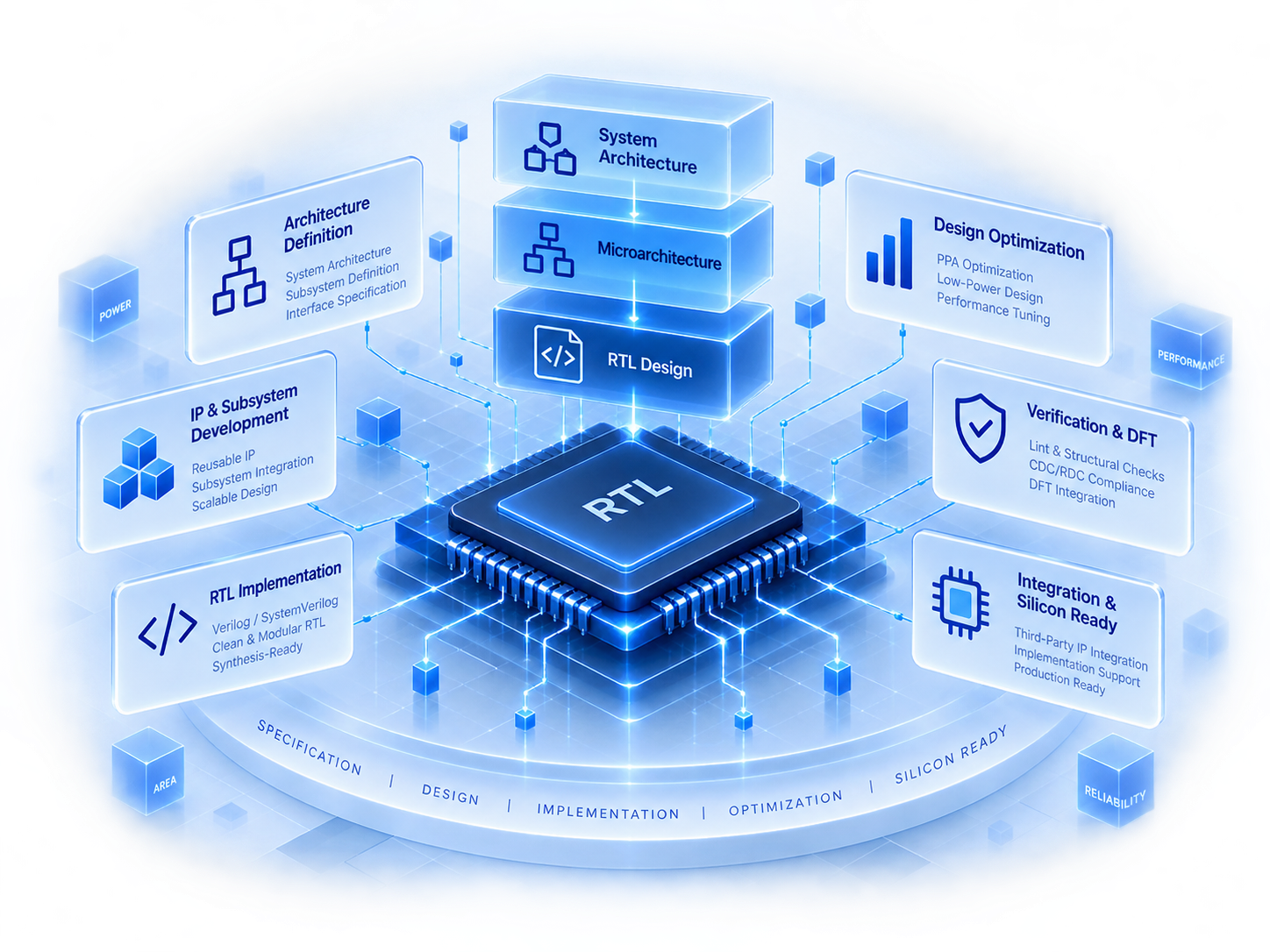
System and subsystem architecture definition
Clock and reset architecture
Microarchitecture development
Low-power RTL implementation
Verilog and SystemVerilog RTL implementation
Power, Performance, and Area (PPA) optimization
IP and subsystem development
Lint and structural quality analysis
Control and datapath design
CDC/RDC-aware design practices
FSM and pipeline architecture
Synthesis-ready RTL delivery
Memory and cache subsystem integration
Third-party IP integration and customization
A disciplined path from concept to silicon execution.
From system intent to implementation, every decision is shaped for clarity, verification, and downstream silicon reality.
Implementation-aware RTL
We translate microarchitectural intent into implementation-aware RTL that balances performance, power, and area without sacrificing clarity or reuse.
Modular by design
Our approach is modular and verification-friendly, enabling clean handoff across the design stack while reducing integration risk and iteration cycles.
Ready for downstream flow
Each design is shaped to be synthesis-ready, lint-clean, infrastructure-aware, and aligned with downstream physical implementation realities.
Architecture and microarchitecture specifications
Design constraints and implementation guidelines
High-quality, synthesizable RTL
Lint and structural quality reports
Interface and integration documentation
Integration-ready design packages